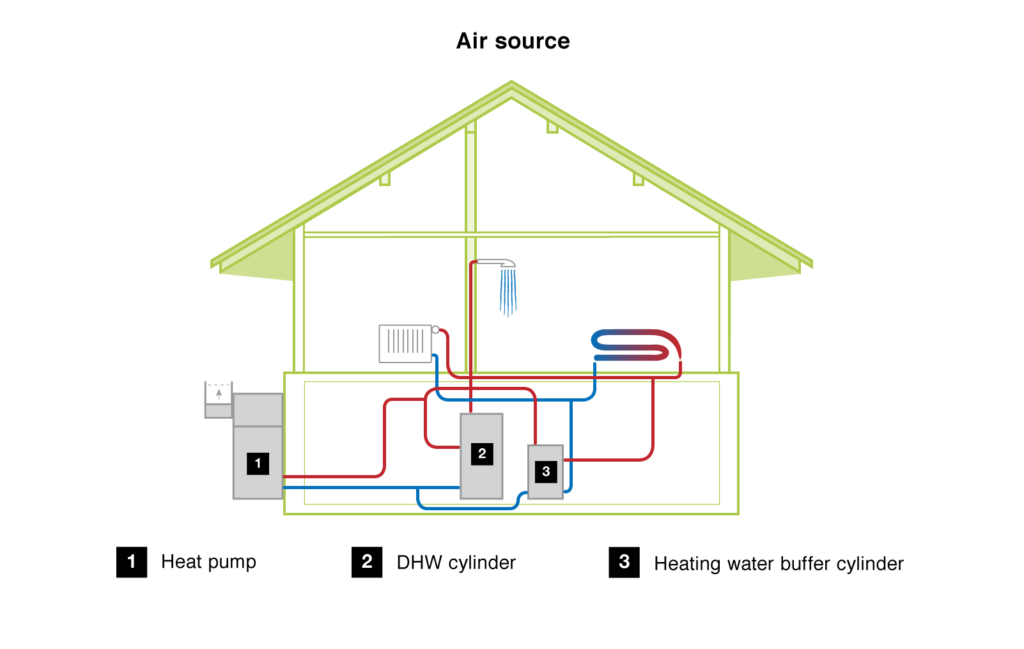
Air source is the most widely installed renewable heating technology in the UK. It suits the majority of sites, costs less to install than ground source, and performs very well with the right design. We run the same heat loss survey on an air source installation as we do on a ground source one.
Prefer to talk it through first? Call 01271 850 040.
Air source specialists
Since 2009
MCS certified for
Air source
We specify
Ecoforest & Maxa
Warranty
5 years
Air source accounts for 97.6% of all Boiler Upgrade Scheme grants paid. Over 60,000 heat pumps were certified in the UK in 2025, the highest year on record, and the majority of them were air source.
It works across the UK climate, in homes and in commercial and public-sector buildings and it is the route most properties will take. It is particularly suited to the South West where winters are milder and temperatures sit above freezing for most of the year.
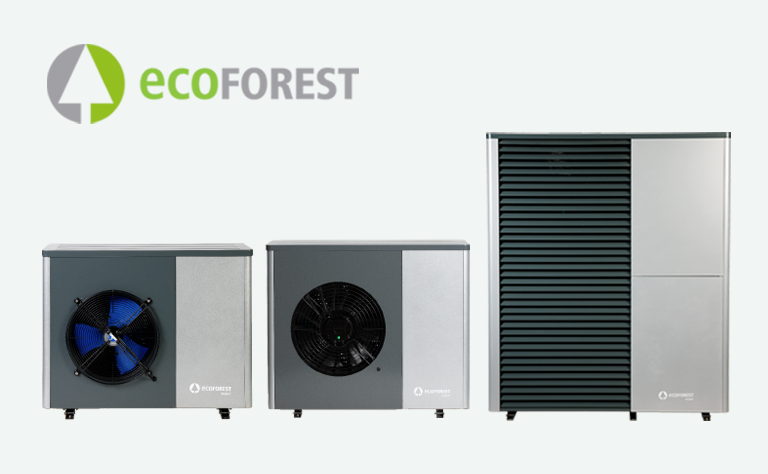
Ecoforest’s R290 air source range, up to 24kW, from one of the first European manufacturers to combine a modulating inverter compressor with a single unit for heating, cooling and hot water.
Typically four to five units of heat for every unit of electricity.
Natural R290, with a very low global warming potential of 0.02
Desuperheater-equipped models produce high-temperature hot water without relying on a separate immersion heater
The built-in ecoSMART energy manager runs the system when electricity is cheapest and stays within your contracted power limit.
App-based monitoring and control for you, remote diagnostics for us. This is our first choice where solar PV forms part of the design either now or in the future.
Stores solar surplus as heat, moving the home towards self-consumption with little or no need for a battery.
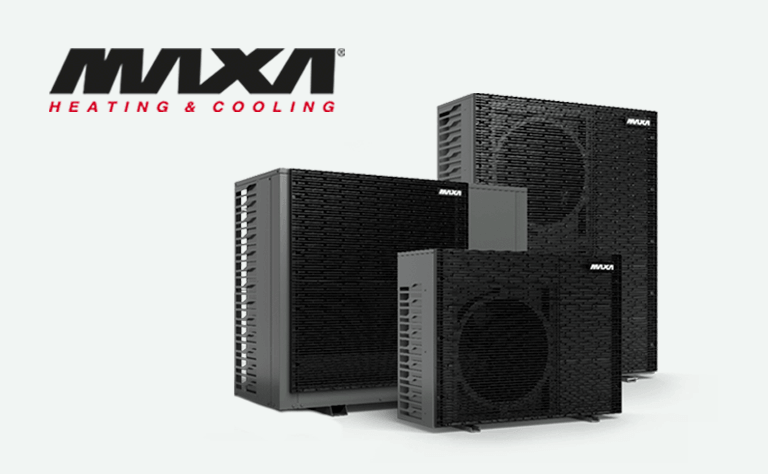
Maxa’s flagship R290 monobloc range, rated to deliver at outdoor temperatures down to −20°C, with high flow temperatures where the emitters call for them. Fourteen models from 6 to 50kW, designed and built at Maxa’s own plant in Italy and supported by a UK sales and aftercare team.
Typically four and a half to five units of heat for every unit of electricity, with A+++ energy efficiency class at 35°C flow across the range.
Natural R290, with a very low global warming potential of 0.02.
Up to 75°C on a continuous basis, which suits properties where the existing emitters need a higher flow temperature than a standard heat pump delivers.
Wi-Fi as standard with the e-PRO controller, the MyMaxa app for monitoring and control, and ModBus RTU as standard where the system needs to talk to a wider building control system.
From 42dB(A) at one metre on the smallest unit. The SL version adds sound-absorbing compressor covers, reducing sound power by a further 2 to 4dB(A) without altering performance.
The Boiler Upgrade Scheme puts £7,500 towards a qualifying air source heat pump, or £9,000 where the property is off the gas grid and currently heated by oil or LPG, on applications made between 21 July 2026 and 31 March 2027. Qualifying work is zero-rated for VAT until 31 March 2027.
Boiler Upgrade Scheme vouchers are valid for three months once approved. We make the application on your behalf and secure the grant before issuing your contract.
Boiler Upgrade Scheme grant towards an air or ground source heat pump, plus 0% VAT on qualifying work.
Yes, when it is sized correctly. The ranges we specify are rated to deliver at outdoor temperatures down to −20°C, which is well beyond anything a British winter produces. Sizing comes from a measured room-by-room heat loss calculation rather than floor area.
Modern units are considerably quieter than their reputation. Permitted development caps sound at 37 decibels measured a metre from the nearest neighbour’s habitable-room window, and we run that calculation as part of the design. Placement makes more difference than the choice of unit.
It depends on your tariff and the system’s SCOP. A well-designed system returns three and a half to five units of heat per unit of electricity, and savings are clearest when replacing oil, LPG or electric heating. We model it against your building and your actual tariff rather than quoting a generic comparison.
Yes, annually. Servicing keeps the system at its design efficiency and is usually a condition of the manufacturer warranty. Our service division looks after systems across the South West, including those installed by other companies.
Yes. Our service team maintains, diagnoses and repairs most major air source brands regardless of who fitted them originally. Find our more about servicing and repairs.
Whether it was installed by us or by someone else, we service, diagnose and repair heat pumps across the South West. Our engineers work on Ecoforest, Maxa, Mitsubishi, Vaillant, Viessmann, Daikin, Samsung, Clivet, Kensa and IDM systems, among others.
Annual servicing keeps performance where it should be and catches small issues before they become expensive ones. If your system is underperforming, our diagnostic service will find out why.
Annual servicing to keep warranties valid and the system running at the efficiency it was designed for.
Something not performing as it should? We’ll identify what’s actually wrong before recommending any work.
Parts and labour repairs, including systems installed by other companies.
We maintain most major brands, including;
Ecoforest · Maxa – Mitsubishi · Vaillant · Viessmann · Daikin · Samsung · Clivet · IDM · Kensa
Based on 210+ reviews on Trustpilot



The right size for your system depends on the property, not its floor area on a form. Tell us about the project, or book a design survey directly and we’ll size it properly.
Prefer to talk it through first?

We design renewable heating systes around your home and the way you live.
Prefer to talk to us first?
Call: 01271 850 040
Whether you’re looking to book a service or ask about diagnostics, it starts with understanding your project.
Prefer to talk to us first?
Call: 01271 850 040