
A water source heat pump is the same machine as a ground source one. We specify the same Ecoforest ecoGEO+; it simply draws its heat from a lake, river or borehole rather than the ground. A closed loop submerges sealed pipework in the water and takes nothing from it, which makes it simpler to consent. An open loop abstracts water, passes it through a heat exchanger and returns it, which is more efficient but needs an Environment Agency licence above 20 cubic metres a day. Efficiency matches ground source, there is no drilling and nothing above ground, and it is funded as ground source under the Boiler Upgrade Scheme.
Prefer to talk it through first? Call 01271 850 040.
Heat pump specialists
Since 2009
MCS Certified for
Ground source
We specify
Ecoforest
HPA Members
Since 2016
Water source is uncommon and entirely site-dependent, which is why few properties are offered it. Where there’s an accessible source, it is worth investigating properly. It sits within the same family as ground source, uses the same heat pumps and is treated the same way for funding.
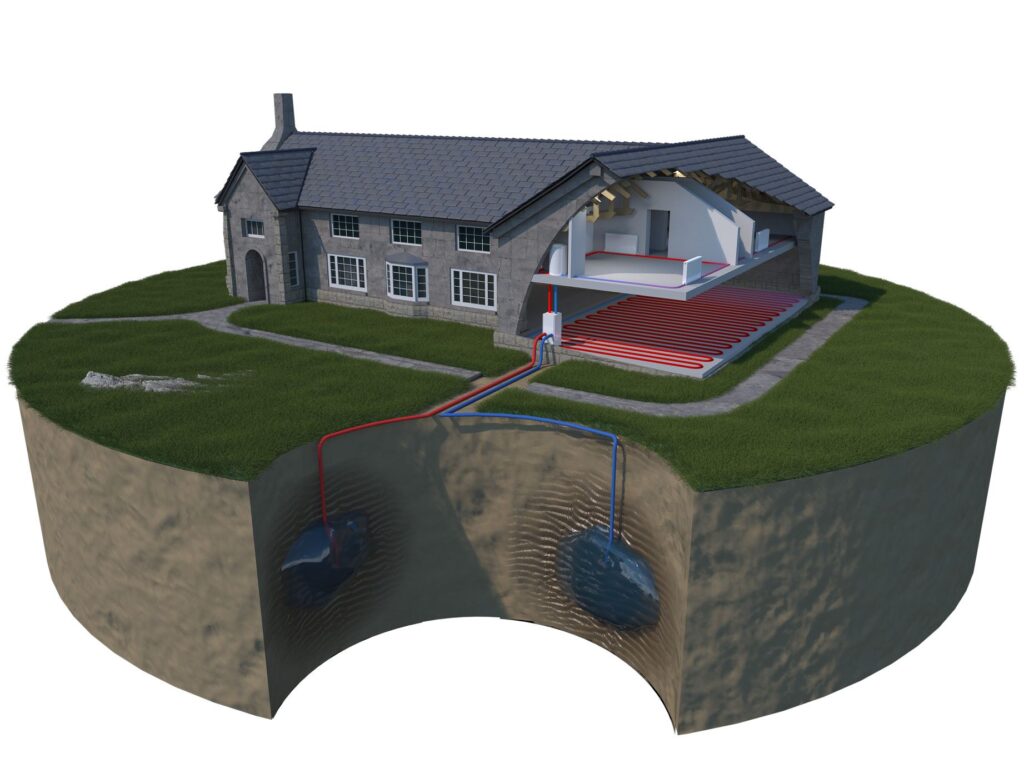
As with ground source, we specify Ecoforest alone. The same ecoGEO+ range operates from a water loop, with the same wide inverter modulation, the same built-in ecoSMART energy manager, and the same heating, cooling and hot water from a single unit.
Typically four to five units of heat for every unit of electricity.
Natural R290, with a very low global warming potential of 0.02.
Desuperheater-equipped models produce high-temperature hot water without relying on a separate immersion heater.
The built-in ecoSMART energy manager runs the system when electricity is cheapest and stays within your contracted power limit.
App-based monitoring and control for you, remote diagnostics for us. This is our first choice where solar PV forms part of the design either now or in the future.
Stores solar surplus as heat, moving the home towards self-consumption with little or no need for a battery.
The Boiler Upgrade Scheme treats water source heat pumps as ground source. £7,500, or £9,000 where the property is off the gas grid and currently heated by oil or LPG, on applications made between 21 July 2026 and 31 March 2027, with the six-month redemption window and the same capacity limits.
Qualifying work is zero-rated for VAT until 31 March 2027.
Boiler Upgrade Scheme grant towards an air or ground source heat pump, plus 0% VAT on qualifying work.
For a closed loop, generally not, provided the system meets the Environment Agency’s exemption conditions. For an open loop, yes: abstracting more than 20 cubic metres a day needs an abstraction licence, and the returned water needs its own permit. We establish which route applies before any design work.
It depends on the building’s calculated heat demand, the depth of the water and how much it moves. Depth and year-round volume matter more than surface area — a deep pond can outperform a wide shallow one. The survey establishes whether the resource is sufficient.
A properly designed closed loop takes a small amount of heat from a large volume and returns nothing to the water. Ecological considerations are part of the consenting process, and we work through them at design stage alongside the Environment Agency’s requirements.
Often, because there is no drilling and less excavation. The saving depends entirely on the site: distance from the water to the plant room, access, and what consents are required. We price both routes where a property could take either.
Four things decide it: the yield the well or borehole can sustain continuously, the water temperature, the water chemistry (iron, manganese and hardness will foul a heat exchanger over time), and where the water goes once the heat has been taken out. Establishing the sustainable yield takes a pumping test by a hydrogeologist, and the design that follows should be indemnified, so the risk sits with the specialist who calculated it.
We coordinate the work, review what comes back, and design the system around what the source is confirmed to deliver. If the well can’t sustain the flow, a closed loop can often use the same borehole or a nearby water body instead.
Whether it was installed by us or by someone else, we service, diagnose and repair heat pumps across the South West. If your heating or air conditioning is due a service, underperforming or needs a repair, our service team can take it on, whoever fitted it originally.
Annual servicing keeps performance where it should be and catches small issues before they become expensive ones. If your system is underperforming, our diagnostic service will find out why.
Annual servicing to keep warranties valid and the system running at the efficiency it was designed for.
Something not performing as it should? We’ll identify what’s actually wrong before recommending any work.
Parts and labour repairs, including systems installed by other companies.
We maintain most major brands, including:
Ecoforest · Maxa · Kensa · Volta · Mitsubishi · Vaillant · Viessmann · Daikin · Samsung · Clivet · IDM
Based on 210+ reviews on Trustpilot




Whether ground source suits your site depends on land, geology and how the property’s heated now. Tell us about the project, or book a design survey directly and we’ll assess it properly.
Prefer to talk it through first?

We design renewable heating systes around your home and the way you live.
Prefer to talk to us first?
Call: 01271 850 040
Whether you’re looking to book a service or ask about diagnostics, it starts with understanding your project.
Prefer to talk to us first?
Call: 01271 850 040