
Most retrofits stop at swapping the heat source. We design a whole intelligent system around the home you already have: heating, cooling, hot water, solar panels and battery storage and controls, working together to cut bills and carbon for the lifetime of the system.
Retrofitting homes across the South West
Since 2009
Ground and air source
Specialists
Certification
MCS | RECC
We specify
Maxa & Ecoforest
Most retrofit quotes treat a heat pump like a direct boiler replacement: same pipework, same radiators, same flow temperature, just a different fuel source. It is often the fastest way to get a heat pump installed but it is usually the reason so many retrofits underperform.
A heat pump asked to hit an old radiator’s flow temperature will do it. It will simply do it inefficiently, every day, for its entire life, and the owner will conclude that heat pumps do not work. Design is what removes that gap.
We start from a proper room by room heat-loss survey of the home as it actually is: the walls, the existing pipe infrastructure, the emitters, and the way the rooms are used. Then we design the system around what we find. Correctly sized radiators so the system can run at a lower temperature. Solar and battery where the numbers justify them. Smart-tariff controls that schedule the whole system to run when electricity is cheapest. You may even want to add cooling and why not if you are investing in a new system.
This is what over seventeen years of experience has taught us. It is the difference between a heat pump that is technically installed and a home that actually performs.
Every retrofit is different, so we don’t start from a fixed product list, we start from the survey. Depending on what the home and what the site allows, a retrofit can draw on any combination of the following, specified to work as one system.
The most common retrofit route, sized correctly against a real heat-loss calculation rather than a rule of thumb.
Where garden or land allows, the highest efficiency and lowest running cost option, and our signature area of expertise.
Generating power the home can use directly or store, reducing what’s drawn from the grid.
Storing solar generation, or cheap off-peak electricity, to run the heat pump or charge an EV when it’s most cost-effective.
Controls that shift the heat pump and battery’s usage to align with time-of-use electricity tariffs automatically.
Increasingly requested as UK summers change, and something a well-designed heat pump system can deliver when connected to the right emitters.
Integrated into the same home energy system rather than added as an afterthought.
Correctly sized radiators, underfloor heating, or a considered mix, so the heat pump runs efficiently rather than working against undersized existing emitters.
Designed as part of the whole system and considers the number of bedrooms, bathrooms and permanent occupants.
Renewable heating decisions made today shape bills, comfort and running costs for years to come. We design every element of a retrofit to work as one system, not four separate purchases.
01
Ground, air, or occasionally water: sized from a proper heat-loss calculation. Where the grounds, geology and budget allows, we lead with ground source for its efficiency and running cost.
02
Heating, hot water for your home, sometimes a pool and increasingly cooling. Solar PV and battery mean the home can generate and store its own energy, ready for smart tariffs from day one.
03
Correctly sized radiators, underfloor heating, fan coils for cooling or a considered mix, designed for efficient low-temperature flow.
04
Controls, monitoring and smart-tariff integration that run the whole system automatically, hybridised and optimised for the lifetime of your system, not just the first winter.
We specify Ecoforest and Maxa heat pumps. Chosen for their advanced specification: smart-tariff ready, hybridisation capable and built to integrate with solar and battery. We lead with ground source: our signature expertise.
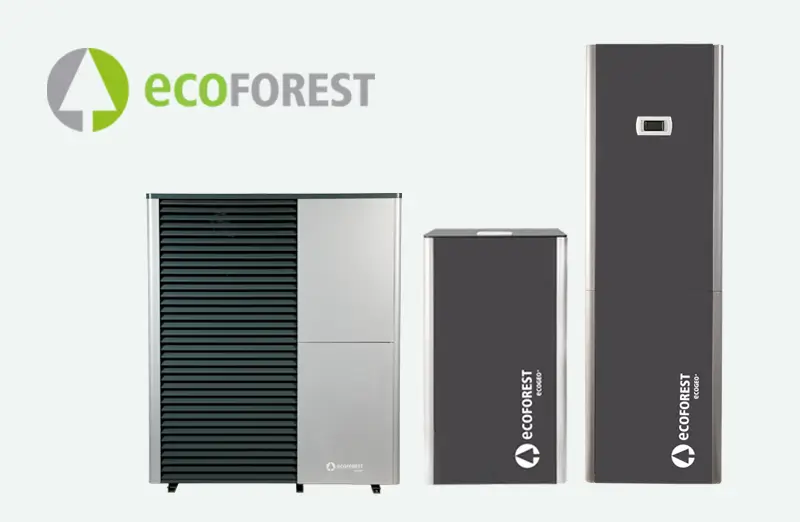
ecoGEO+ LITE and ecoGEO+ B/C PRO ground source; ecoAIR+ air source.
Inverter
ecoGeo+: R290 1-6kW/2-10kW/4-16kW R454B 12-45kW/15-60kW/20-85kW ecoAir+: R290 1-7kW/1-9kW/3-12kW/ 3-18kW/6-24kW.
Up to 70°C with no electrical support.
Natural R290 across the ranges we fit.
R454B on the High Power ground source range.
ecoSMART energy manager, with metering and internet control built in.
Air source heat pumps offering a wide range of outputs and high temperature design.
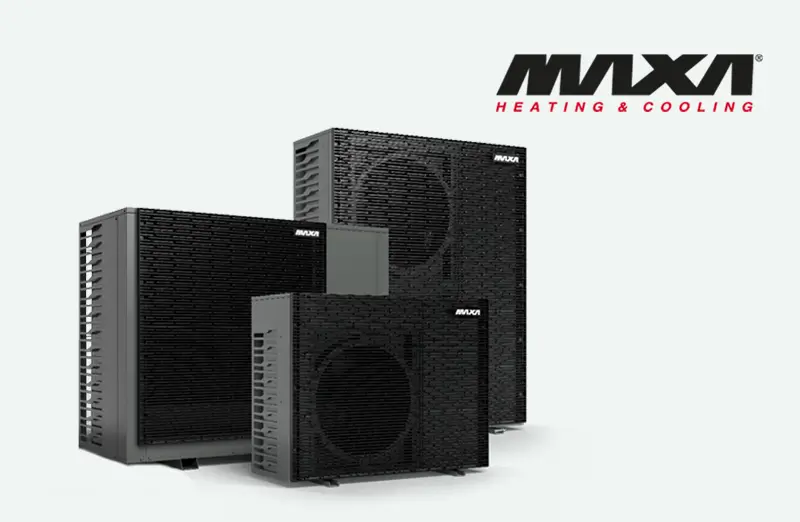
i-290 Maxa Gamma & i-32V5.
Inverter
i-290 Maxa Gamma: 10 models from 6-50kW. V5: R32 - 7 models from 6-18kW. Midi: R32 - 4 models from 21-32kW.
Up to 75°C.
Natural R290 & R32.
e-PRO controller with Wi-Fi as standard, the My Maxa app, and ModBus RTU.
A well-designed retrofit is not just about the system. It is also about what is available to help fund it.
£7,500 Boiler Upgrade Scheme grant available towards a qualifying air or ground source heat pump installation. Or £9,000 where the home is off the gas grid and currently heated by oil or LPG, on applications made between 21 July 2026 and 31 March 2027, plus 0% VAT on qualifying work.
Air source vouchers are valid for three months once approved. Ground source vouchers are valid for six months, useful where emitter upgrades are also needed and the project takes longer to coordinate.
Boiler Upgrade Scheme grant towards an air or ground source heat pump, plus 0% VAT on qualifying work.
Usually not. Both technologies sit under permitted development for most homes in England, and the air source rules were widened in May 2025.
For air source, permitted development covers you provided the outdoor unit is no larger than 1.5 cubic metres, is not on a pitched roof or a wall above ground-floor level facing a highway, meets MCS 020(a) (the noise standard, capped at 37 decibels measured a metre from your nearest neighbour’s habitable-room window), and is not used solely for cooling.
In a conservation area, permitted development still applies for unlisted buildings, with one addition: the unit must not sit on a wall or roof fronting a highway, or nearer to the road than the building itself.
Listed buildings are the exception. Permitted development does not apply to them at all. Listed building consent is needed as well as planning permission, and carrying out the work without consent is a criminal offence.
Ground source is usually permitted development because the array is underground and there is no external unit to site. This is one of the reasons it suits sensitive and listed buildings. We establish all of this at survey and handle the applications where needed.
No. It can sit some distance away against an outbuilding, behind a hedge, or at the far side of a courtyard. On the systems we mostly specify, what travels between the unit and the house is water, not refrigerant. The pipework is pre-insulated and buried.
Every metre of pipe run loses a small amount of heat and costs a little pumping energy. We calculate that loss and size the pipe and its insulation against it rather than guessing. Ten metres is routine. Considerably further is achievable where there is a good reason.
There are good reasons to move a unit away from the house. Distance from a neighbour’s window is the single biggest lever on the noise assessment, so relocating can turn a marginal site into a straightforward one. Appearance is the other consideration: against a period elevation, out of sight matters more than pipe run.
Wherever it goes, it needs clear airflow, somewhere for defrost water to drain, room to service it, and an electrical supply run to it.
Ground source removes the question altogether. There is nothing above ground to place, and the heat pump is installed inside the property in a plant room or garage.
Usually not. Most homes run a heat pump on their existing single-phase supply with no change at all. What we check at survey is the main fuse rating and whether there is spare capacity in the consumer unit. Occasionally the main fuse needs upgrading, for example from 60 or 80 amps to the 100 amps that’s now standard. That’s arranged through the regional network operator rather than by us, and it’s usually straightforward.
Where supply genuinely becomes a design question is when a heat pump, solar panels, a battery and an EV charger all sit on the same house. That is a load management problem rather than a capacity one, and it is something we plan for at design stage. Once the design work is complete, we handle the network operator notification and the application for solar and battery where one is needed.
It is also worth reviewing your electricity tariff. There are now tariffs built specifically around heat pumps, solar hybridisation and battery storage, with access to off-peak pricing that can significantly reduce running costs.
Yes, if it is specified that way from the start. A reversible heat pump cools as well as heats. What decides whether it works well is not the heat pump but what is in the room.
Fan coils move air across a chilled coil and manage the condensation that comes with cooling. They cool a room quickly and are the right choice for a heavily glazed or south-facing space. Underfloor cooling takes the edge off a warm day rather than transforming it. Radiators cannot cool: there is nowhere for condensation to go, and convection does not work in reverse.
So cooling is a room-by-room decision made at design stage. Adding it afterwards often means opening up floors and walls that are already finished. One practical note: the system is heating, cooling or making hot water at any given moment, so hot water is typically scheduled in short bursts overnight on cheap electricity.
Some, usually. Not all, and not automatically. A radiator’s output falls as the water temperature drops, so one sized for a 70°C boiler delivers roughly half as much heat at the temperature a heat pump runs at. Whether that matters depends on the room.
We ask the question room by room: at the design flow temperature, does this radiator still meet this room’s calculated heat loss? For a fair proportion of rooms in most houses, the answer is yes. Where it is not, there are more options than people expect. A deeper panel in the same footprint, a second radiator, a fan-assisted unit where wall space is tight, or underfloor heating where the floor is coming up anyway.
The counter-intuitive part: older houses often need less work than newer ones. Large Victorian cast-iron radiators carry a lot of water and a lot of surface area, which is exactly what a heat pump wants. Small modern panel radiators in a 1990s house are frequently the harder problem. We measure this during the survey and tell you before you commit.
Often yes, but it needs calculating rather than assuming. A heat pump needs roughly four times the flow rate of a boiler to deliver the same heat, and small-bore pipe only carries so much. The heat-loss survey we carry out will quickly help us assess whether the existing pipework is workable and whether any part of it needs upgrading. Microbore is the limiting factor more often than the radiators are, and it is worth establishing early.
Modern units are considerably quieter than the reputation suggests, but they are not silent. Permitted development caps sound at 37 decibels measured a metre from your nearest neighbour’s habitable-room window. Not at your boundary, and not at your own house.
What you will actually hear is a fan, and behind it a compressor. Both are quietest at part load, and a modulating heat pump spends most of the year there. The units we specify run at a fraction of their maximum output for most of the heating season. They are loudest in the coldest weather, which is also when every window in the neighbourhood is shut.
Placement is where careful survey work earns its keep. Distance from bedroom windows and boundaries is the main lever. Hard surfaces reflect sound, so a unit tucked into a narrow passage will measure considerably worse than the same unit in open air. Fixing directly to a house wall can carry vibration into the structure, which needs anti-vibration mounts rather than just more distance. We run the MCS 020(a) calculation as part of the design.
Ground source removes the question entirely. There is no outdoor unit, no fan and no defrost cycle. The only sound is the indoor unit in a plant room or utility, at a level comparable to a fridge.
Whether it was installed by us or by someone else, we service, diagnose and repair heat pumps across the South West. Our engineers work on Ecoforest, Maxa, Mitsubishi, Vaillant, Viessmann, Daikin, Samsung, Clivet and IDM systems, among others.
Annual servicing keeps performance where it should be and catches small issues before they become expensive ones. If your system is underperforming, our diagnostic service will find out why.
Annual servicing to keep warranties valid and the system running at the efficiency it was designed for.
Something not performing as it should? We’ll identify what’s actually wrong before recommending any work.
Parts and labour repairs, including systems installed by other companies.
We maintain most major brands, including;
Ecoforest · Maxa · Kensa · Mitsubishi · Vaillant · Viessmann · Daikin · Samsung · Clivet · IDM
One relationship from first survey to lifetime service. We design and install your system, then look after it for as long as you own it.
01
Full heat-loss survey and design. It’s the foundation of everything.
02
A whole intelligent system specified around your home.
03
Our own engineers, installed to MCS standards.
04
Tuned, tested and handed over running intelligently.
05
Diagnostics, maintenance and repair for as long as you own it.
Based on 210+ reviews on Trustpilot





There’s no instant online estimator here, because a retrofit that’s actually designed around your home can’t be priced from a form.
It starts with a heat loss survey. Tell us about the property and how you live in it, and we will arrange a design survey. The survey is free and there is no obligation.
Prefer to talk to someone?

We design renewable heating systes around your home and the way you live.
Prefer to talk to us first?
Call: 01271 850 040
Whether you’re looking to book a service or ask about diagnostics, it starts with understanding your project.
Prefer to talk to us first?
Call: 01271 850 040